
What is NPSH Margin and How is It Determined?
In the world of pumping systems, reliability is everything. Whether moving water to municipalities, supporting industrial processes, transporting hydrocarbons, or serving critical power generation applications, pumping systems are expected to operate efficiently and continuously. One of the most important factors influencing pump reliability is adequate Net Positive Suction Head (NPSH) margin, which is why the ANSI/HI 9.6.1 Rotodynamic Pumps Guideline for NPSH Margin has become an essential resource for engineers, system designers, pump manufacturers, and end users across the industry.
The guideline provides recommended NPSH margins for rotodynamic pumps, including radial, mixed-flow, and axial-flow pump designs. Its purpose is straightforward: help ensure that the available NPSH or NPSHA in a system exceeds the pump’s required NPSH or NPSHR by an appropriate amount, which limits cavitation and promotes reliable operation.
What is NPSH margin?
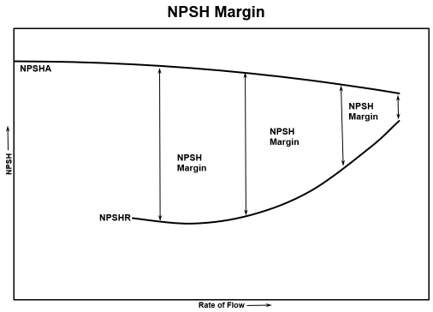
It is the difference between the NPSHA which is a system dependent value and the NPSHR which is a pump dependent value. Image 1 illustrates NPSHA, NPSHR and the resulting NPSH margin as a function of flow rate.
Why is this NPSH margin so important?
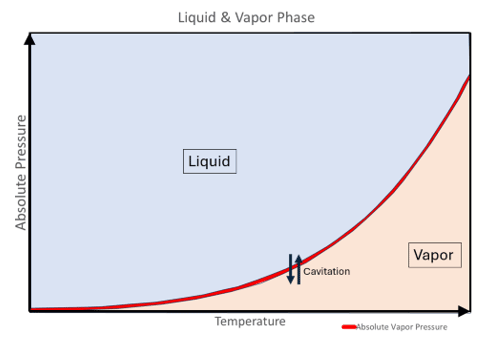
When insufficient NPSH margin exists, cavitation can result in unacceptable performance and reliability, which is extremely hard to correct after the system has been designed and the pump selected. As illustrated in Image 2, cavitation occurs when the local pressure drops below the liquids absolute vapor pressure. This can happen for many reasons, but in pumps it is typically associated with pressure at the impeller inlet falling below the liquid’s vapor pressure, causing vapor bubbles to form and subsequently collapse back to liquid as they move through the pump to a region where the pressure is above the liquid vapor pressure. The results can be increased noise and vibration, reduced performance, component damage, shortened equipment life, and unplanned downtime. In critical applications, these consequences can translate into substantial maintenance costs, production losses, and operational risk. So, ANSI/HI 9.6.1 serves as a valuable resource in the pump system design and pump selection phase to remedy these potential issues.
ANSI/HI 9.6.1 helps the industry address these challenges by providing application-based guidance rather than a one-size-fits-all approach. The guideline recognizes that the recommended NPSH margin may vary based on operating conditions, fluid characteristics, pump design, and the market segment being served. It includes recommendations for a broad range of industries, including petroleum processing, chemical processing, water and wastewater, power generation, pulp and paper, irrigation, slurry handling, oil and gas, building services, and general industrial applications.
The biggest update in the recent 2024 edition transitions from using NPSH3 which is a testing standard where total head is reduced by 3% due to cavitation as the basis for margin determination to using NPSHR, which is published by the manufacturer and may be a value greater than NPSH3. Refer to HI standards for precise definition of NPSHR and NPSH3 as these are just descriptive relationships for this article. This change improves consistency and makes the guideline easier for users to apply during pump selection and system design. The revision also updates NPSH margin considerations and introduces guidance that can be applied broadly across all market segments.
Beyond limiting cavitation, ANSI/HI 9.6.1 supports a larger industry goal: lifecycle optimization. Pumps represent a significant investment, and reliability issues can increase energy consumption, maintenance expenses, and total cost of ownership. By applying the guideline’s recommendations during system design and pump selection, organizations can improve operational stability, extend equipment life, and reduce unexpected failures.
Standards and guidelines play a critical role in creating consistency across the pump industry, and ANSI/HI 9.6.1 is a prime example. It provides a common framework for manufacturers, consultants, engineers, contractors, and end users to evaluate NPSH requirements using a shared set of principles. This common understanding helps reduce design uncertainty, improve communication among stakeholders, and ultimately deliver more reliable pumping systems.
Standards developed by the Hydraulic Institute are developed by industry experts serving on a committee to ensure balance of opinion, lack of dominance and an open process so that consensus can be reached. This results in requirements and guidelines the industry can stand behind. This could not be accomplished without the committee leadership and members who volunteer their time and effort to advance the industry through this process.
For additional information on the topic of NPSH and cavitation, refer to Hydraulic Institute Standards at www.pumps.org/standards and training offered by Pump Systems Matter at https://training.pumps.org.