
Pump System Certification
HOME / Why Certify / Certification Process / Prepare For the Exam / RECERTIFICATION /FAQs
Demonstrate your Commitment to Excellence and Professional Growth
Pump System Certification (PSC) provides a clear, standardized pathway designed to deepen your technical knowledge and validate the skills employers value most.
Unlock your potential with credentials backed by the Hydraulic Institute—the industry’s leading authority.
- Build comprehensive, real-world pump system knowledge
- Validate in-demand skills trusted by employers
- Earn recognition as a well-rounded, skilled practitioner
Ready to Get Started?
A Progressive Learning and Certification Path for the Industry
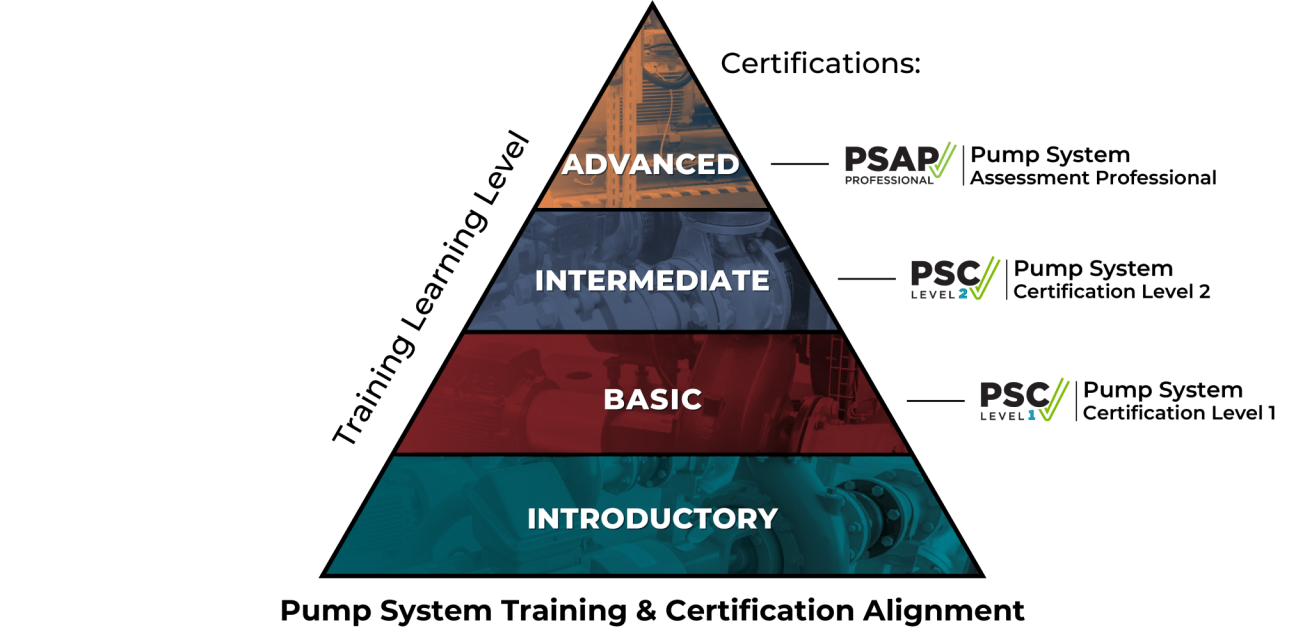
Certification and training in pump systems is not linear, but it is deliberately progressive. Each certification and training level builds upon the previous one, strengthening the skills and competencies required to advance—and enhancing the overall value you bring to your organization and career.
Explore Certifications


PSC Level 1 certified individuals understand the purpose, function, types, and operating characteristics of pumps and systems. They have a strong understanding of performance curves, basic understanding of system curves, and can complete basic calculations related to affinity rules and power consumption. This knowledge enables them to make informed decisions and prepares them to collaborate with more experienced individuals in support of solving complex issues.
Audience: Engineers, Sales/Application personnel, and Operation/Maintenance technicians
Recommended Training: PSC Level 1 Training Catalog ⇗
PSC Level 1 Knowledge Topics:
For the PSC Level 1 Body of Knowledge, refer to Appendix A of HI 41.8 Program Guideline for Pump System Certification.
Preview knowledge topics below.

Pump Basics (10%)
a) Summarize basic pump function and purpose of major pump components
b) Identify pump terminology, descriptions, and acronyms
c) Identify a bare pump along with the basic components of a pump with driver and an extended pump product
d) Identify common pump types including overhung impeller, between bearing, vertically suspended, rotary and reciprocating pump types
e) Explain the basic operating theory of a RD pump
f) Explain the basic operating theory of a PD pump
g) List general application considerations for RD pumps
h) List general application considerations for PD pumps
i) Compare and contrast the general shape and general characteristics of RD and PD performance curves
j) Compare the different natures of flow generated by rotary and reciprocating pumps

Pump Performance Curves and Power Consumption (15%)
a) Identify and describe types of performance curves that may appear on a pump performance graph
b) Identify and explain basis of and information plotted or indicated on the pump curve
c) Define and calculate pump output power, pump input power, and electrical input power (the latter both with and without a Variable Speed Drive [VSD])
d) Convert between horsepower (hp) to kilowatts (kW)
e) Calculate flow, head, and power changes per the affinity rules

Pump Systems (15%)
a) Explain the purpose and function of pumps and pump systems
b) Define the terms fluid and liquid
c) Describe fluid properties that affect pump and system performance
d) Identify types of horizontal and vertical pump systems
e) Identify boundaries for determining the system curve
f) Explain purposes of system types
g) Define pressure and head – and their relationship
h) Cite and define all types of pressure
i) Identify the component parts of pump total head
j) Use charts to determine friction loss through pipes, valves, and fittings
k) Define the system curve
l) Understand why the system curve determines the operating head and flow rate
m) Explain characteristics of flat and steep system curves
n) Explain cavitation and how it affects a pump system
o) Calculate friction loss through pipes, valves, fittings via simple calculations for pipe or fittings given variables
p) Define Net Positive Suction Head Required (NPSHR), Net Positive Suction Head – 3 (NPSH3), Net Positive Suction Head Available (NPSHA), Net Positive Inlet Pressure Required (NPIPR), Net Positive Inlet Pressure Available (NPIPA), and Net Positive Suction Head (NPSH) margin
q) Describe system factors that affect the pump allowable operating region (AOR)

Rotodynamic Pump Designs and Types (10%)
a) Identify the three major categories of rotodynamic pumps
b) Calculate specific speed
c) Identify common components in the construction of rotodynamic pumps
d) Compare and contrast characteristics of the performance curves based on specific speed
e) Identify the shapes of the four major types of impellers
f) Describe and explain the purpose of impeller balancing
g) Identify the various types of pump casings and discharge collectors
h) Identify and describe the characteristics of overhung, between bearing, vertically suspended pumps
i) Compare and contrast pumps that are flexibly coupled, close coupled and rigidly coupled
j) Identify deep set and short set vertical turbine pumps
k) Identify open lineshaft pumps and enclosed lineshaft pumps
l) Relate categories of RD pumps and their associated specific speeds
m) Identify sealless pumps
n) Describe methods to control leakage across the impeller from high pressure to low pressure within the pump and effects on pump performance
o) Identify the pump preferred operating region
p) Describe pump design considerations that affect the allowable operating region

Positive Displacement Pump Designs and Types (5%)
a) Explain how positive displacement pumps generate flow
b) Identify and describe the two positive displacement types – rotary and reciprocating
c) Describe the component construction and performance characteristics of rotary pumps
d) Describe the component construction and performance characteristics of reciprocating pumps
e) List types of rotary and reciprocating pumps
f) Cite application considerations supporting use of positive displacement pumps
g) Identify common components in the construction of positive displacement pumps
h) Explain relationship of flow rate to positive displacement pump speed
i) Explain why positive displacement total differential pressure is not related to speed and what dictates the maxi-mum total differential pressure
j) Explain the importance of pressure relief valves for use with PDs
k) Calculate output power and input power by a positive displacement pump

Pump Components and Accessories (5%)
a) Compare and contrast basic mechanical seals and packing types
b) Explain the purposes of packing and seal glands
c) Identify lubrication and cooling methods for packing
d) Identify and describe mechanical seal plans – and support systems when applicable
e) Describe bearings and bushings used in pumps
f) Explain why bearing seals are used
g) List bearing lubrication methods and lubricants
h) Describe the types of static sealing
i) Explain the purpose of couplings, drive shafts, and gears between the driver and the pump
j) Explain data on a typical nameplate for the pump

Drivers and Drives (5%)
a) Compare and contrast pump drivers, including electric and non-electric types.
b) Describe construction and features for electric motor types
c) Describe motor frame sizes and standard dimensions
d) Explain relevant driver standards
e) List motor electrical parameters
f) List types of data found on technical data sheet, characteristic curve, and nameplate
g) List motor enclosures and their suitable uses
h) List driver starting methods
i) Describe features and characteristics of Variable Frequency Drives
j) Describe VFD installation and environment considerations including temperature and altitude

System Design Considerations (5%)
a) Identify and explain purpose of major pump system components
b) Describe examples of end use equipment
c) Identify purpose of applicable standards
d) Identify common pump industry symbols, icons, subscripts, and abbreviations

Varying the Pump Operating Point (6%)
a) Explain design point on a pump curve, and why alternate operating points may be required
b) Apply affinity rules based on impeller diameter and speed changes
c) Cite methods to modify pump performance or control the flow or pressure: On/Off, throttling, bypass, variable speed, and impeller trim
d) Explain implications of various curve shapes, including flat and steep
e) Explain parallel pumping and how it impacts flow and head
f) Explain series pumping and how it impacts flow and head

Pump Selection and Specification (5%)
a) Determine most applicable pump types for common applications
b) List sizing/selection – application data requirements
c) Describe liquid characteristics and the effect on pump selection
d) Select appropriate pump based on hydraulic selection criteria provided (i.e. flow, head, and NPSHA)
e) Discuss common materials of construction for wet end parts and the factors affecting their selection

Testing (5%)
a) Describe performance test – flow, head, power
b) Describe pump efficiency, bowl efficiency, and overall efficiency
c) Explain what differentiates a certified curve from other performance curves
d) Compare and contrast non-witnessed and witnessed tests
e) Understand hydraulic test acceptance grades variances
f) Describe hydrostatic pressure test
g) Describe Maximum Allowable Working Pressure (MAWP)

Pump Installation, Commissioning, and Startup (4%)
a) Identify key elements of site drawings
b) Locate critical information in an instruction and operation manual
c) Identify key pump components and their item numbers in a parts manual
d) List general safety consideration for operating a pump system
e) Describe suitable pump foundation, grouting and anchoring as applicable for the installation
f) Explain startup checklist, personnel, data collection, system settings, and planned sequence of actions
g) Describe when priming is required

Maintenance (3%)
a) Cite steps in a typical maintenance program for a pump system
b) List tools and instruments typically required of pump system maintenance personnel
c) List general safety considerations for operating a pump system
d) Inspect mechanical seals and packing
e) Understand the need for calibration of instruments

Troubleshooting (3%)
a) List causes of insufficient pressure
b) List causes of insufficient rate of flow
c) List causes of increased power or power overload
d) List causes of high vibration (1x, 2x, vane-pass frequencies)
e) List causes of premature internal pump wear

Pump System Optimization and Analysis (2%)
a) Describe pump Life Cycle Cost (LCC), each component and typical hierarchy of costs
b) Define pump system optimization
c) List broad categories to optimize a pumping system (lower head, lower flow rate, improve installation, improve control, etc.)

Markets and Applications (2%)
a) List typical application considerations in market segment: Agricultural
b) List typical application considerations in market segment: Chemical
c) List typical application considerations in market segment: Commercial Building
d) List typical application considerations in market segment: General Industrial
e) List typical application considerations in market segment: Municipal
f) List typical application considerations in market segment: Oil and Gas
g) List typical application considerations in market segment: Power Generation
h) List typical application considerations in market segment: Residential

Level 2 certified individuals have applied knowledge of the purpose, function, and operating characteristics of positive displacement and rotodynamic pumps and systems. They have a strong understanding of pump industry best practices, calculations, and tools to solve common pump and system operating issues. The candidate should be able to diagnose equipment, acceptable pump performance, installation, and operational issues, and identify energy optimization opportunities.
Audience: Engineers, as well as Technical Sales personnel who desire to advance their knowledge
Recommended Training: PSC Level 2 Training Catalog ⇗
PSC Level 2 Knowledge Topics:
For the PSC Level 2 Body of Knowledge, refer to Appendix B of HI 41.8 Program Guideline for Pump System Certification.
Preview knowledge topics below.
Pump Basics (2%)
a) Summarize basic pump function and purpose of major pump components
b) Identify pump terminology, descriptions, and acronyms
c) Identify a bare pump along with the basic components of a pump with driver and an extended pump product
d) Identify common pump types including overhung impeller, between bearing, vertically suspended, rotary and reciprocating pump types
e) Explain the basic operating theory of a RD pump
f) Explain the basic operating theory of a PD pump
g) List general application considerations for RD pumps
h) List general application considerations for PD pumps
i) Compare and contrast the general shape and general characteristics of RD and PD performance curves
j) Compare the different natures of flow generated by rotary and reciprocating pumps
Pump Performance Curves and Power Consumption (4%)
a) Compare and contrast fixed speed and variable speed pump curves.
b) Identify parallel and series pump curves
Pump Systems (9%)
a) Describe considerations in determining Net Positive Suction Head (NPSH) margin
b) Explain how flow requirements are determined for simple and complex application examples
c) Calculate NPSHA and NPIPA based on site conditions and liquid properties
d) Describe the nature of Newtonian and non-Newtonian liquids
e) Calculate complex friction loss through pipes, valves, fittings by gathering information, variable data and for multiple fittings/pipe
f) Understand the use of the Darcy Weisbach Equation and the Hazen Williams Equation
g) Apply Bernoulli’s Equation relative to flow through pipes, nozzles, etc.
h) Describe system transients during pump start-up and shut-down
i) Calculate a system curve for simple systems
j) Describe tools used to calculate system curves for complex or variable systems
Rotodynamic Pump Designs and Types (14%)
a) Explain impeller trimming methods
b) Describe balance methods, grades, and applicability for different impeller and pump designs
c) Describe types of pump casings and discharge collectors and their applicability to application requirements
d) Identify and describe the characteristics of regenerative turbine, self-priming, sealless pumps, multi-stage, slurry, and special effect pumps
e) Identify design considerations of each RD pump type
f) Describe and explain the configurations and purposes of double casing pumps
g) Describe shaft and column stretch and why it is important to consider
h) Compare and contrast specific speed and suction specific speed
i) Describe factors that will affect pump attainable efficiency
j) Calculate suction specific speed
k) Discuss design considerations when there is potential for reverse flow through the pump
l) Identify and explain location and role of the cutwater area of volute
m) Describe radial thrust, the causes, and mitigation strategies
n) Describe axial thrust, the causes, and mitigation strategies, including momentum change
o) Describe shaft deflection and stress, the causes, and mitigation strategies
Positive Displacement Pump Designs and Types (7%)
a) Explain factors that affect positive displacement pump efficiency
b) Explain starting and low speed operation considerations of PD pumps being constant torque devices
c) Describe self-priming characteristics of PD pumps
d) Describe single acting, double acting, triplex, multiplex, etc.
e) Describe the purpose of Air Operated Diaphragm (AOD) pump
f) List various names for metering pumps
g) List metering pump types (diaphragm, piston, plunger, solenoid operated etc.)
h) Explain nature and purpose of turndown ratio of metering pumps
i) Discuss design fit or running clearances between the pumping element
j) Explain factors that affect pump slip
k) Discuss unbalance forces and how they change with operating speed
l) Compare and contrast design features of timed and untimed rotary pumps
Pump Components and Accessories (5%)
a) Explain lubrication and cooling methods for packing
b) Compare and contrast bearing lubrication methods, lubricants, and support systems
c) Explain and describe the various types of pump bases
d) Explain the purpose for external and internal coatings on pump components and/or pumping units
e) Apply coupling selection and sizing methods
f) Describe variable speed drive train devices
g) Describe advanced mechanical seal types
h) Describe thrust bearing location relative to the coupling
i) Discuss and identify seal plans
j) Describe the purpose of flywheels and their effect on the rotating element
k) Discuss common system accessories used in reciprocating pumps
l) Discuss gear sets and their use in pumping
m) Discuss non-VFD variable speed drives
Drivers and Drives (5%)
a) Explain impact of speed-torque curves on motor selection for RDs and PDs
b) Explain locked rotor torque
c) Explain service factor and how it is used
d) Explain power factor
e) Explain allowable starts per hour for across the line and reduced voltage starts
f) Explain precautions for altitude considerations for drivers and drives
g) Explain purpose of anti-reverse mechanisms
h) Compare and contrast submersible and immersible motors
i) Explain submersible motor cooling and how it is accomplished
j) Explain lightning and surge protection for motors
k) Explain precautions for Explosion Proof (EXP) designs and hazardous locations
l) Describe features and characteristics of Variable Frequency Drives (VFDs)
m) Explain VFD operating principles
n) Describe VFD controls and applications
o) Cite motor design considerations for use with VFDs (i.e., inverter duty motors)
p) Explain VFD selection and configuration related to constant and variable torque loads
q) Discuss cable length, shielding, grounding, and electromagnetic interference (EMI)
r) Explain line harmonics and filters
s) Discuss the typical uses of direct current (DC) motors with pumps
System Design Considerations (9%)
a) Compare and contrast system design for fixed and variable operating conditions
b) Explain how end-use equipment establishes flow demand(s)
c) Identify typical codes and regulations that apply to pump systems
d) Describe system plans and information required for pump specification
e) Explain control methods and associated instrumentation
f) Discuss application considerations for flooded suction and suction lift
g) Describe importance of free surface intake and inlet piping design on pump performance and reliability
h) Explain submergence and its effect on pump system design
i) Explain role of outlet piping velocity in system design
j) Describe system considerations that affect the applied pump nozzle loads
k) Discuss when pressure pulsation control is needed and the devices that are used
l) Discuss safety design considerations for the system to protect equipment, environment, and people
m) Explain purposes of a Programmable Logic Controller (PLC) and a Human-Machine Interface (HMI)
n) Identify and use system process flow, mechanical, electrical, instrumentation, isometric drawings, and associated symbols.
o) Identify and define various communication protocols
p) Describe purpose of seismic analysis
q) Identify when water hammer (hydraulic transient) is more prone to occur and when mitigation should be considered
Varying the Pump Operating Point (5%)
a) Describe advantages and disadvantages of various methods used to control and change the operating point
b) Explain implications of various curve shapes, including curve with dip and curve with droop
c) Explain application of control curves when using variable speed control
d) Analyze various application scenarios to determine the most suitable control
e) Discuss control strategies used to stage parallel pumps when using variable speed control
f) Describe common applications for parallel and series pumping
Pump Selection and Specification (9%)
a) Explain strategies for pump selection to meet various design conditions
b) Explain duration diagram (flow rate versus time)
c) Explain how to establish flow/head requirements based on a duration diagram
d) Select pump type and configuration
e) Select types of drivers, couplings, bearings, mechanical seals or packing, baseplate, sensors and controls, communication protocols and devices, etc.
f) Determine suitable testing requirements
g) Perform interpretation of specifications, sizing and selection of the pump system components
h) Describe different liquid characteristics and their effect on pump performance and selection.
i) Compare and contrast North American and ISO pump characteristics
j) Discuss types of corrosion (general, pitting, crevice, galvanic, erosion)
k) Explain real world pump operation uncertainty vs specified performance
l) Discuss common materials of construction for wet end parts and the factors affecting their selection
Testing (7%)
a) Calculate pump total head
b) Explain associated measurement uncertainties
c) Describe mechanical integrity test
d) Describe vibration test
e) Explain procedures, test arrangements and possible modifications required to complete the performance tests
f) Describe equipment and methods used to determine the pump tested values per applicable standards
g) Discuss procedures, and test arrangement to complete hydrostatic pressure testing
h) Explain laboratory instrument calibration and frequency
i) Select instrumentation to meet required measurement uncertainty
j) Describe tests specific to slurry pumps
k) Describe motor tests
l) Describe sound testing methods
m) Describe motor performance and integrity tests
n) Describe string test
o) Explain model testing (of large pumps)
p) Describe NPSH and NPIP tests
q) Describe Maximum Allowable Working Pressure (MAWP) and its use in hydrostatic tests
r) Explain how NPIPR is determined for positive displacement pumps
Pump Installation, Commissioning, and Startup (7%)
a) Identify and discuss pipe and tube connection designs and sealing methods
b) Explain and identify suitable pump foundation, grouting and anchoring as applicable for the installation
c) Describe and evaluate elements of proper free surface intake and pump suction piping, and understand what problems can occur if not done properly
d) Describe elements of proper pump discharge piping
e) Define and explain importance of verifying that nozzle loads are within acceptable limits, considering thermal, mechanical, and pressure forces
f) Describe process of aligning drivers and various pump configurations
g) Describe limitations of instrumentation and test setup for field testing
h) Explain priming methods
Maintenance (5%)
a) Describe contents of installation operation and maintenance manual and pre-shutdown checklists including per-sonnel, data collection, system settings, and planned sequence of actions
b) Explain how to determine if a pump is operating according to its required flow rate and head or pressure
c) Identify allowable limits for vibration, temperature, power, etc.
d) Describe typical maintenance monitoring and adjustment if applicable for mechanical seals and packing
e) Document dimensions of wear surfaces and check per Instruction and Operation Manual (IOM)
f) Perform methods for alignment of driver and pump shaft
g) Explain practices for short- and long-term storage of pumps
h) Perform inspection steps during operation
i) Explain condition monitoring
j) Describe calibration of instruments
k) Explain condition based maintenance
l) Explain metrics used to describe the pump or a population of pumps reliability or availability (e.g., Mean Time Between Repair [MTBR])
m) Describe the current state and uses of the Internet of Things (IoT) and Industrial Internet of Things (IIoT) for machinery monitoring and maintenance
Troubleshooting (6%)
a) List causes of abnormal noise
b) List causes of high seal temperature and failures
c) List cause of high bearing temperature and failures
d) List cause of lube oil leakage
e) List causes of pump overheating or seizure
f) Describe potential causes of water hammer. g) Discuss failure modes of valves, drives, drivers, and other system components
h) Identify and provide solutions to insufficient pressure
i) Describe elements and process of root cause failure analysis
Pump System Optimization and Analysis (2%)
a) Describe pump Life Cycle Cost (LCC), each component and typical hierarchy of costs
b) Define pump system optimization
c) List broad categories to optimize a pumping system (lower head, lower flow rate, improve installation, improve control, etc.)
Markets and Applications (4%)
a) Discuss market influences, trends, and considerations

Pump System Assessment Professional (PSAP) certification provides confidence to pump end-users and other stakeholders that pump system assessors have the knowledge and experience to perform high-quality assessments which will lead to energy-efficient and reliable pumping systems.
Audience: Engineers, after-market and field services personnel, and technical sales with a desire to advance knowledge
Recommended Training: PSAP Training Catalog ⇗
PSAP Knowledge Topics:
For the PSAP Body of Knowledge, refer to Appendix A of HI 40.8 Program Guideline for Pump System Assessment Professional Certification.
Preview knowledge topics below.
| K-1 Pump types (e.g., centrifugal, positive displacement, vertical turbine, etc.) | K-18 Measuring devices and their requirements and proper applications |
| K-2 Pump system components (e.g. tanks, valves, pipes, sealing, heat exchangers, couplings, etc.) | K-19 Common operating problems and errors |
| K-3 Pump system component interactions | K-20 Pump and motor performance curve |
| K-4 Standard pump system operating procedures | K-21 System curves |
| K-5 Benefits of pump system optimization | K-22 Parameter estimation methods |
| K-6 Factors that impact pump efficiency and reliability (e.g. size, age, installation, process change, fluid properties, pressure head flow, etc.) |
K-23 Data (electrical, vibration, thermography, etc.) and its relationship to reliability |
| K-7 Factors that affect pump system reliability and efficiency (e.g. age, installation, piping modifications, system controls, hydraulic design modifications, instrumentation, operational parameters, etc.) |
K-24 Reliability metrics |
| K-8 Elements of lifecycle costing | K-25 Currently available equipment and technology |
| K-9 Basic pump maintenance practices | K-26 Industry best practices |
| K-10 Piping and instrumentation diagrams | K-27 Basic financial analysis |
| K-11 Isometrics | K-28 Utility rate structures and incentives |
| K-12 Process flow diagrams | K-29 Principles and techniques of prioritizing solutions/td> |
| K-13 Blueprints | K-30 Elements and layout of a pump system assessment report |
| K-14 Key plant personnel (positions) needed on the assessment team | K-31 Presentation techniques |
| K-15 Roles and responsibilities of an assessment team | K-32 Techniques for assisting clients/customers in aligning goals and strategies with assessment recommendations |
| K-16 Field measurement parameters and their acceptable ranges | K-33 Implementation strategies |
| K-17 Hydraulic and electrical formulae | K-34 Commissioning |