
After a Fall in Pump Efficiency, Refurbishment Offers Pay Back in Under 2 Years
After pump efficiency fell from 90.5 to 85.5 percent, a water distribution pump was refurbished. The refurbishment resulted in the pump being able to provide a higher head with a better efficiency at the same flow rate. Because the pump output could be matched to the system requirements by the installed variable frequency drive, the refurbishment reduced the power absorbed and achieved a payback period of under two years.
Category: Blogs, Case Studies December 1, 2025
Intended Audience: Water supply, pump operators
Objective: Determine if the costs to refurbish the pump achieve payback in a reasonable time period.
Description of System: On-site monitoring by the thermodynamic method of efficiency measurement.
Description of Intervention: showed that the pump efficiency had fallen, over the 10 years since it was installed, from 90.5 to 85.5 percent. Refurbishment would cost 9000 Euro. Refurbishment would increase head at a given rate of flow and increase efficiency. The pump output could be matched to system requirements by the installed variable frequency drive. Therefore, the net effect was a reduction in power absorbed.
See Table 1 below:
Table 1: Summary of Results
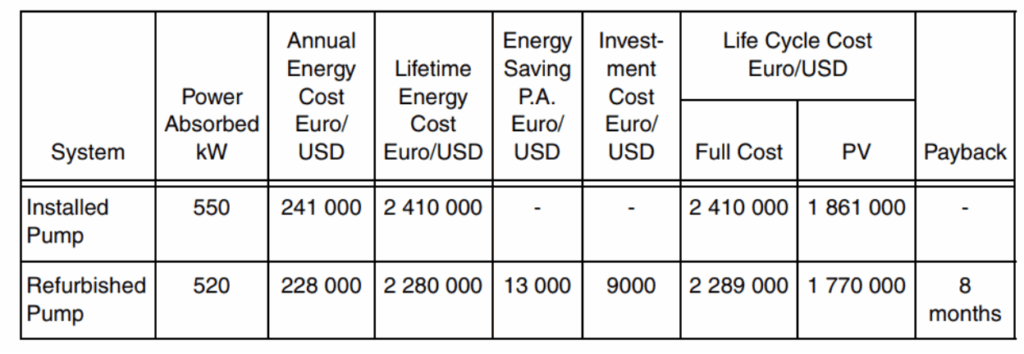
Summary of Results: The site determined that refurbishment of the pump would cost 9000 Euro. After refurbishment, the power absorbed was reduced by 30kW, resulting in payback achieved by improved efficiency is a short period.
For a pump of this size, a 20,000 Euro expenditure to gain 5 points in efficiency would provide a payback in less than 2 years. The full results are shown in Table 1.
Conclusion: For pumps with high energy consumption, refurbishment can offer a short payback period. Monitoring of pump efficiency can help in determining when it is appropriate to refurbish equipment – particularly on pumps that are high-energy, arduous duties, or handle dirty liquids – as they will deteriorate more quickly and need to be assessed more frequently.
A pump operator should recheck the actual duty and resize the impeller, if appropriate, on fixed-speed applications. If the duty has changed significantly, it may be beneficial to see if the pump manufacturer can supply a new impeller to better match the duty.
Written by:
Members of the Pump Life Cycle Cost Committee, 1st Edition
Published In: Pump Life Cycle Cost: A Guide to LCC Analysis for Pumping Systems, 2nd Edition
Year of Publication: 2021
Pump Life Cycle Costs: A Guide to LCC Analysis for Pumping Systems – 2nd Edition – Pumps.org
SUBSCRIBE TODAY
Get the latest pump industry news, insights, and analysis delivered to your inbox.