
Installing High-Temperature Seals to Prevent Added Cooling and Heating Processes
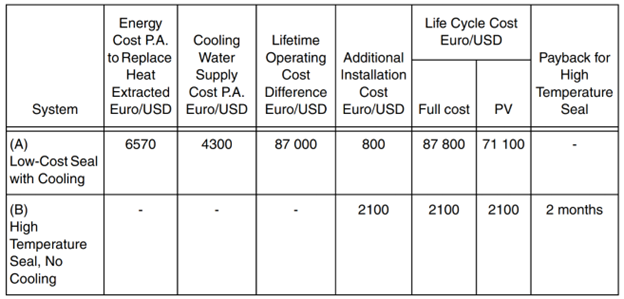
For a process requiring a charge of liquid at 210°C, an alternative, high-temperature seal is considered to reduce the cost of the system. This high-temperature seal eliminates the need for a cooling system and a reheating system. The high-temperature seal results in the installation being paid off in two months.
Category: Blogs, Case Studies April 1, 2026
Intended Audience: Chemical Processing, Heated Liquids
Objective: Determine if adding a high-temperature seal will improve the operating costs of a pump system that currently requires a cooling and reheating process.
Description of System: The process requires a charge of liquid at 210°C (410°F). The first option is as follows:
A simple mechanical seal with auxiliary, one-pass cooling system to reduce the temperature at the seal to 150°C (302°F), at which temperature it can operate satisfactorily. The cooling water supply to the seal removes heat from the area around the seal and from the seal chamber itself. The heat extraction is calculated to be at a rate of 10 kW (13.6 Hp), in this case, but can be as high as 50 kW (68 Hp), in certain designs. This energy must be replaced by additional process heating, which would be electrical energy in this case. There is an additional cost to supply the cooling water from the plant water ring main, which includes a cooling tower. The water cost is calculated at 1 Euro (USD)/m3/h and a rate of flow of 0.5m3/h (2 USgpm) is required to keep the temperature rise of the cooling water below 20°C (68°F). There is also an additional installation cost of 800 Euro/USD to pipe in the water supply from the nearest point in the plant circuit to the pump and standby.
Description of Intervention: The alternative option is a high-temperature seal, which will operate, uncooled, at 210°C (410°F). The extra cost for the special seal for the pump and standby is 2100 Euro/USD.
Summary of Results: The high temperature seal results in the installation being paid off in two months of time making it a worthwhile investment. See Table 1 for the complete results.
Table 1: Summary of Results
Conclusion: Switching to a high temperature seal that does not require external cooling simplifies the overall system and can result in a cost savings.
Written by:
Members of the Pump Life Cycle Cost Guidebook Committee, 1st Edition
Published In: Pump Life Cycle Cost: A Guide to LCC Analysis for Pumping Systems, 2nd Edition
Year of Publication: 2021
SUBSCRIBE TODAY
Get the latest pump industry news, insights, and analysis delivered to your inbox.