
Installing Multiple Pumps to Reduce the Life Cycle Cost of an Air Conditioning System
A new air-conditioning system was required to meet variable chilled water demand. Three system configurations were evaluated: A single pump with a bypass line, a single pump with a flow control valve, a three-pump system with variable frequency drives (VFDs).
Category: Blogs, Case Studies June 2, 2026
Intended Audience: Building Services, HVAC
Objective: Choose the pump system with the best life cycle cost for a hotel’s new air-conditioning system.
Description of System: A new air-conditioning system was required for a hotel. Three types of pump and system selection were considered. There was a variable demand for chilled water and the profile of required flow against time was analysed. Total time per annum over which some flow was required was 7000 hours and the variable demand was simplified in profile into four time/demand duties for selection and analysis purposes. Required flow varied considerably from 51 to 204 m3/h (220 to 895 USgpm). The peak flow was required for only 3 percent of the time.
Description of Intervention: In the simplest evaluated system (A), a single pump, sized for the peak demand, runs continually at this duty with surplus water recirculated when demand is reduced. Pump size: 125 mm (5 in.) discharge, 250 mm (10 in.) impeller, 1750 rpm fixed speed motor of 18.5 kW (25 Hp). In system (B) a single pump sized for the peak demand, as in (A), is controlled in rate of flow by a control valve. At the reduced demand the pump operates back along its curve which reduces the power absorbed (true of most centrifugal pumps). Operation at zero flow must be prevented. In system (C), three pumps are installed, each capable of approximately one-third the maximum demand. They can be switched in and out and also run at variable speed to meet the variable demand and match the lower system head losses at reduced rate of flow. Pump size: 3 identical pumps, 80 mm (3 in.) discharge, 125 mm (5 in.) impeller, 3500 rpm maximum speed with 7.5 kW (10 Hp) motors, and variable frequency drive
Summary of Results: This case history illustrates that a pump running unnecessarily on full capacity has the lowest energy efficiency. A throttle valve is better but is still a poor system. A further 30 percent reduction in energy consumption is possible with variable frequency and switchable control of a multipump installation
In system (B) the pump runs at partial capacity for much of its life, increasing loads, and vibration, which may have a detrimental effect on bearing and seal life. In system (C), the pumps run at lowest possible speed benefiting pump life. However, maintenance on four small pumps is more expensive than two large pumps.
Table 1: Summary of Results
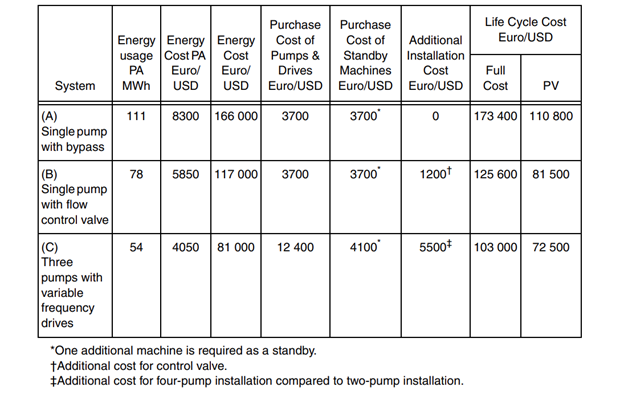
Conclusion: Installations with wide variations in flow with friction loss system characteristics will benefit from variable from variable frequency drive.
Written by:
Members of the Pump Life Cycle Cost Guidebook Committee, 1st Edition
Published In: Pump Life Cycle Cost: A Guide to LCC Analysis for Pumping Systems, 2nd Edition
Year of Publication: 2021
SUBSCRIBE TODAY
Get the latest pump industry news, insights, and analysis delivered to your inbox.