
Combination Soft Starter Eliminates Piping Cavitation and Reduces Energy Consumption in Steel Mill Spray Nozzle Pumps
A steel mill runs a 150 kW (200 hp) rotodynamic pump to supply pressure to a hood spray nozzle. The nozzle is only required to spray 40% of the time. The pressure is controlled by a bypass valve and orifice, which causes the pump to operate at 44% of the BEP. The system additionally has significant audible cavitation downstream of the orifice. After considering three options, a 150 kW (200 hp) combination soft starter was chosen to allow the pump to be turned off when the nozzle is not required to spray. The combination soft starter resulted in a simple payback period of 0.12 years.
Category: Blogs, Case Studies October 1, 2026
Intended Audience: Facility Managers, Mill Engineers
Objective: Reduce the maintenance costs and energy consumption of a 150 kW (200hp) hood spray pump.
Description of System: The subject pump is a hood spray pump installed in a steel mill that operates 7200 h/year. This 140 kW (200 hp) rotodynamic pump supplies pressure to the hood spray nozzle, which is only required to spray 40% of the time. Pressure is controlled with a bypass valve and orifice, as shown in Figure 1.
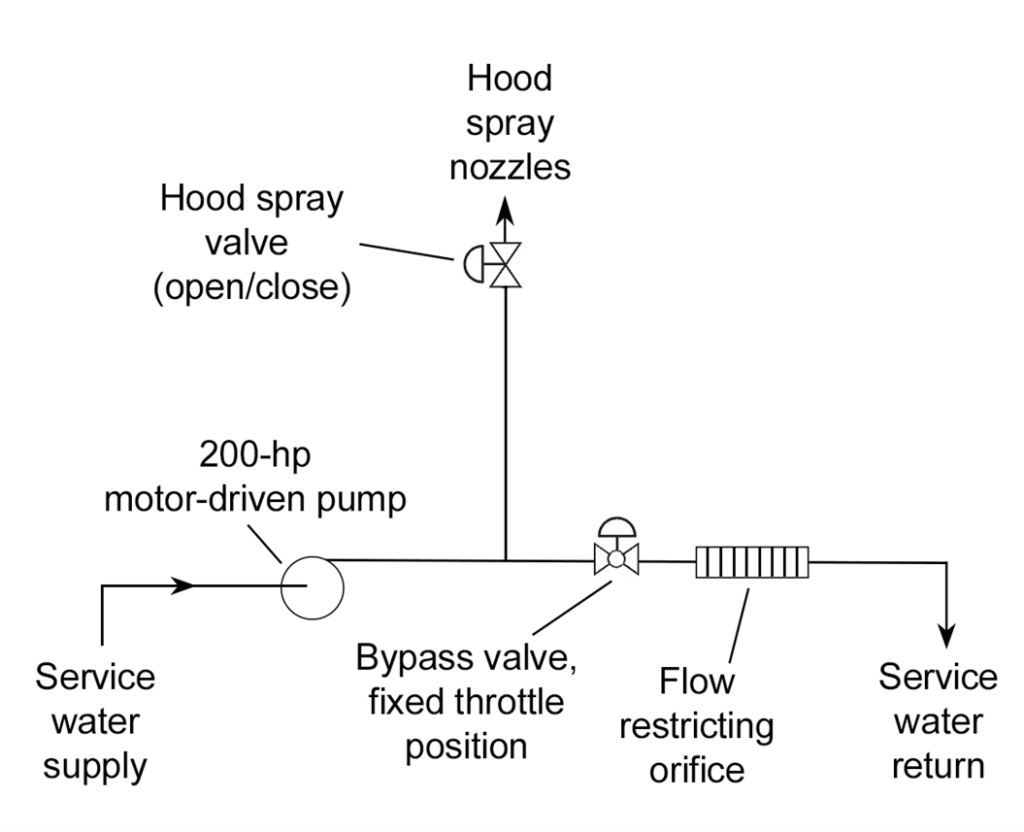
Figure 1: System Schematic
When the spray is not required, all flow discharges through the bypass line. Under this condition, operation is at 44% of the 180 m3/h (800gpm) flow rate, as shown in Figure 2. When the hood spray nozzle was open, the pump consumed ~150 kW (200 hp), and when the spray nozzle was closed, the pump consumed ~123 kW (165 hp).
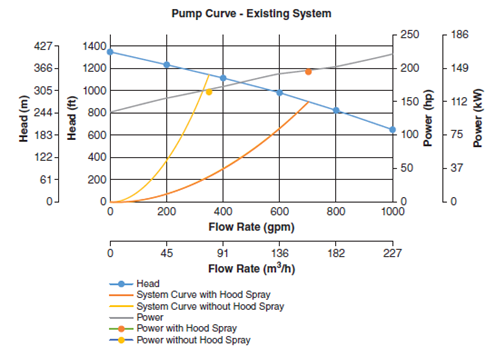
Figure 2: Pump and system curves
When the pump is not delivering flow through the spray nozzle, it is significantly oversized. This represents approximately 60% of its operating time.
Operation in this mode results in excessive pressure loss across the flow-restricting orifice, which both wastes energy and causes significant audible cavitation within the piping system. This cavitation has resulted in erosion damage to the piping downstream of the orifice, requiring regular maintenance (see Figure 3). Additionally, the average power consumption, including motor inefficiency, is 145 kW (194 hp). This costs the end user $62,500 at a rate of $0.06/kWh.
In addition to the routine operation and maintenance costs of $100,000 per year, the end user spends an estimated $50,000 annually to repair pump damage caused by low flow rate operation and bypass piping damage caused by cavitation.
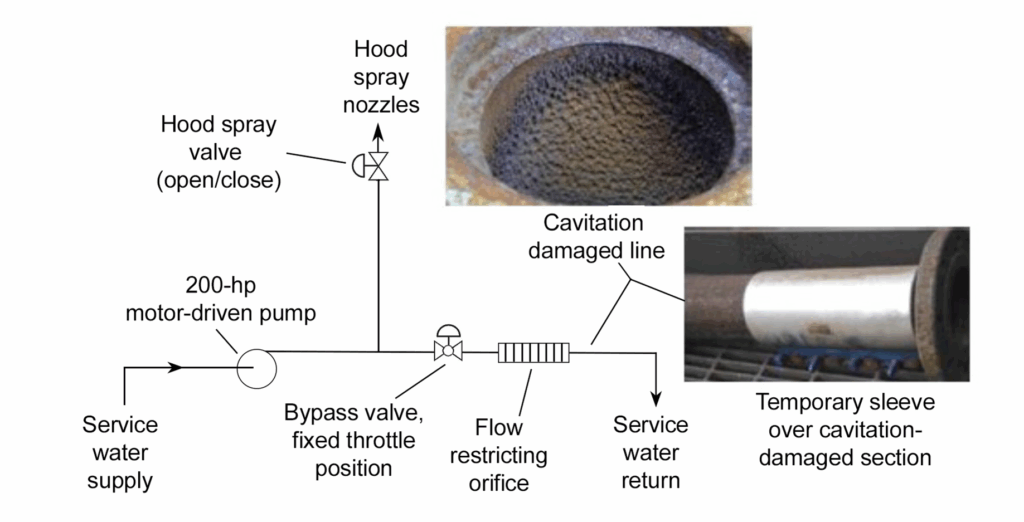
Figure 3: System schematic with cavitation damage
There were several red flags in this system that indicated it should be assessed for optimization:
- High maintenance costs
- Relatively high energy (150 kW (200 hp))
- Pump running 100% of the time in batch process system
- Audible cavitation
- Bypass line continually open
Description of Intervention:
The system was reviewed by an assessment engineer who considered the following elements1:
- Capital costs of solution
- Installation and commissioning
- Energy usage
- Operation and maintenance
Solution 1: Replace Motor with More Efficient One
The current 150 kW (200 hp) motor is older and less efficient than newer models. It could be replaced by a new, premium motor with 95% efficiency.
This option would cost $10,000 for the motor and $3000 for installation. A total of 4 kW (5 hp) of power for 7200 h/year would be saved, resulting in 28,800 kWh savings annually. At $0.06/kWh, this results in annual energy costs of $60,800, representing a savings of $1700.
While this option reduces total energy costs, it does not eliminate the low flow-related pump and piping maintenance costs.
Solution 2: VFD Implementation
Implementing a variable frequency drive (VFD) would allow the pump to operate closer to its best efficiency point when not discharging through the spray nozzle. For this installation, variable speed could be implemented to operate the pump at 70% speed (its minimum allowable), which would draw 80 kW (110 hp) less, as shown in Figure 3.
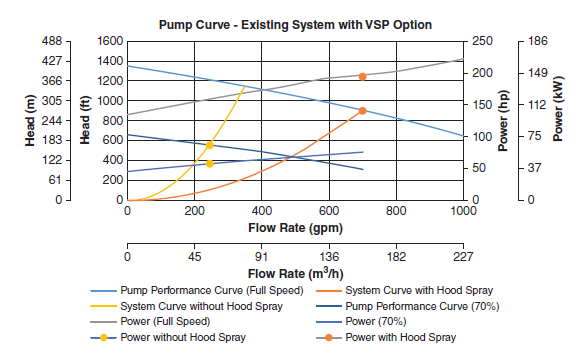
Figure 4: Variable speed pumping option
Upgrading the motor to inverter duty would cost $13,000. Purchase and installation of a 150 kW (200 hp) VFD would cost $20,000.
For this solution, a total of 80 kW (110 hp) of power for 4000 h/year would be saved, resulting in 320,000 kWh savings annually. At $0.06/kWh, this would result in annual energy costs of $43,500, representing a savings of $19,000. Furthermore, the additional $50,000 repair maintenance costs would be eliminated.
Solution 3: 200-hp Combination Soft Starter
Installing a 150 kW (200 hp) combination soft starter would allow the pump to be turned off during the 60% of the time that the nozzles are not spraying, which would limit the stress on the motor and pump caused by cyclic operation. Historical data shows that the pump cycles approximately five times per hour.
This option requires the purchase and installation of a soft starter and controls. The cost of purchase and installation would be $10,000.
This solution would eliminate 4320 h of 123 kW (165 hp) of power, resulting in 530,000 kWh savings annually. At $0.06/kWh, this would result in annual energy costs of $30,700, representing a savings of $31,800. Furthermore, the additional $50,000 repair maintenance costs would be eliminated.
Summary of Results: A lifecycle cost (LCC) analysis was performed to determine the best solution. A summary is provided in Table 1:
| LCC elements | Original | Solution 1 | Solution 2 | Solution 3 |
| Project capital cost | N/A | $13,000 | $33,000 | $10,000 |
| Annual energy cost | $62,500 | $60,800 | $43,500 | $30,700 |
| Annual O&M cost | $150,000 | $150,000 | $100,000 | $100,000 |
| Total annual cost | $212,500 | $210,800 | $143,500 | $130,700 |
| Annual savings | N/A | $1700 | $69,000 | $81,800 |
| Simple payback | N/A | 7.5 years | 0.5 years | 0.12 years |
| Project life | 10 years | 10 years | 10 years | 10 years |
| Discount rate | 4% | 4% | 4% | |
| IRR | 5% | 209% | 824% | |
| NPV | $790 | $525,000 | $660,000 |
Table 1: LCC Analysis
Recognizing the low LCC, the steel mill decided to implement Solution 3. This solution eliminates the bypass line as part of the system and adds controls to start and stop the pump when spraying is required. The payback summary is reported in Table 2
| Total annual savings | $81,800 |
| Project capital cost | $10,000 |
| Project life | 10 years |
| Discount rate | 4% |
| NPV | $660,000 |
| Simple payback | 0.12 years |
Table 2: Simple payback summary of Solution 3
Conclusion: Installing a 150 kW (200 hp) combination soft starter allows the pump to be turned off when not needed, making it an ideal solution for a process with frequent cycling. In this case, implementation of this solution saved the end user significant cost in both energy usage and expected maintenance, resulting in a simple payback period of 0.12 years.
Written by: Members of the Committee, 1st Edition
Published In: Pump Systems Optimization: A Guide for Improved Energy Efficiency, Reliability, and Profitability
Year of Publication: 2018
SUBSCRIBE TODAY
Get the latest pump industry news, insights, and analysis delivered to your inbox.